
Summer is here, and while the first three weeks of June were in the lower 80’s and rainy, this last week has been hot. The official temp has been in the mid to upper 90’s, so that makes my place, upper 90’s to low 100’s. Good thing there is still storms twice a week! The rabbits are doing good for the temperatures. I give them ice bottles and my barn is setup to maximize air flow while minimizing the amount of sun that can come in. About mid July, once the temps stay consistent, I will start running the AC for them. The reason I wait, is so I can regulate the barn’s temperature more easily. While the dwarf’s could handle the constant and often sudden temperature changes that would happen if I started the AC earlier; Chester, who is extremely sensitive to temperature changes, could not; and would most likely end up sick. Speaking of Chester, before it got too hot I sheared him so he could survive the heat better. Shearing angora rabbits is not like shearing a thick or double coated dog. Dogs like Golden Retrievers, Chow Chows, Akitas, Siberian Huskies and Alaskan Malamutes should NEVER be sheared. These dogs have hair and not wool. Hair is not meant to be taken off and gives protection against the sun, however, when the hair is sheared, the skin is no longer protected. The heat and burning rays from the sun can now get down to the dog’s skin causing severe sunburn and overheating. Wool on the other hand, is meant to be taken off and is likely to cause overheating if left on. This is why sheep, lamas, alpacas, and angora goats do just fine when they are sheared. Angora rabbits can be either sheared or brushed to get their wool off. Depending on the rabbit, they may prefer one method over another. Chester, prefers shearing. So every 3-4 months, I shear him down to about 1″. This way his skin is still protected from biting flies, but the hot wool is not there. Since I do not show Chester, I don’t have to worry about keeping his wool long and tangle free. Also, his wool grows fast, so I’m getting about 2.5-3″ of wool every time I shear him. Here is a picture of Chester halfway through shearing. His coat looks choppy because I use scissors, as I’m not confident that clippers won’t cut him.

Summer is also the time for babies! The Memorial Day litter is starting to eat solid food and drink water. They are 4 weeks now and will be ready for new homes on July 27. I’m planning on taking them to the show in Henderson that day; where hopefully they will find their new homes. Here’s a picture of them eating.

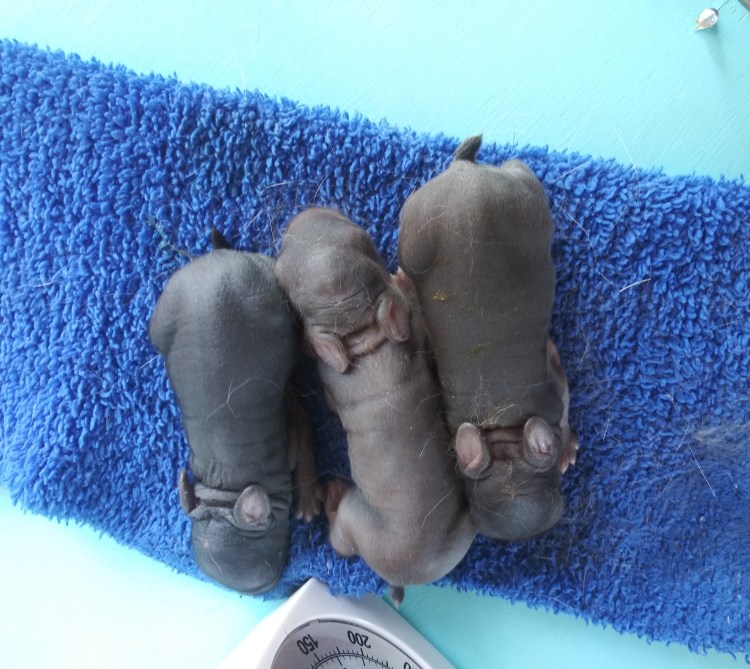
I also have some babies from my new doe Reese’s. She came to me pregnant and had 5 kits. However, two of them were deformed and dead when I found them. The first one was half the size of normal newborns and severely deformed. The second one was not found until cleaning the tray a couple days later. This one was only developed to the point of being marble sized, without any definition of limbs or head. Due to the graphicness of the pictures, I will not be sharing them. I had read about the effect GMO feed has on rabbits; birth defects, sterilization, and stillborn kits are some of the effects. So I contacted the prior owner, and she confirmed my thought that this could be the cause of the defects. While not all the ingredients need to be GMO to get birth defects, the primary GMO ingredients that are used, are Soy, Corn, Wheat and sometimes Alfalfa. Genetically Modified Organism/Genetically Engineered (GMO/GE) plants are those that have had their DNA chemically changed to allow the use of harsh weed killers on the growing plants without harming them. This is done by adding the “DNA” of the weed killer to the DNA of the plant. Making it part of the plant and therefore, when the growing plant is sprayed with the week killer, its is being sprayed with its self and remains unharmed. While this sound like a good thing, the effects of consuming this are far from good. What makes things hard is that most of the soy, corn and wheat that is readily available, has been modified, and depending on who the alfalfa is sourced from, it could be modified as well. While I have been careful on what type of feed I get for my rabbits, I haven’t insisted on non-GMO/GE feed. And while I’ve never had any problems, because of this experience I will be changing my feed to a certified, organic, non-GMO/GE feed. This will definitely cost more, but I’d rather pay more in feed costs with healthy rabbits; than buy cheap food and have deformed or sterile rabbits. Here is a picture of the 3 healthy newborn kits.
Until next time, Happy Hopping!
 Laughing Lapins